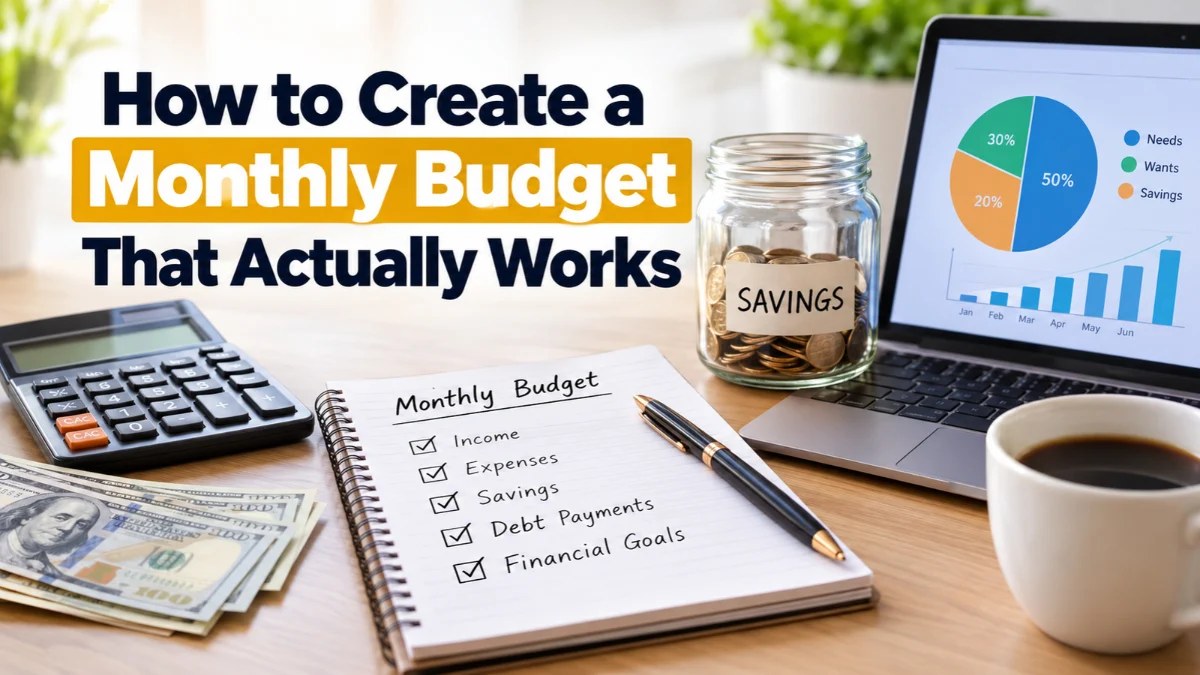
Most budgeting advice sounds like an extreme diet: cut out all joy, track every 50-cent stick of gum, and spend your Sunday evenings crying over a complicated spreadsheet.
Then life happens. Your car’s alternator dies, a friend invites you to a wedding, or you simply get exhausted from logging receipts. You overspend, feel guilty, abandon the system, and decide you are “just bad with money.”
You are not bad with money. The system you were handed was simply built for a robot, not a human.
A sustainable budget isn’t a financial straitjacket designed to stop you from living. It is simply a roadmap that gives your money clear directions so you don’t spend the end of every month wondering where it went.
Here is a step-by-step, realistic guide on how to create a monthly budget that fits your actual life, handles unexpected hits, and sticks for the long haul.

What Is a Monthly Budget?
A monthly budget is a plan for how you will use the money you earn during a month. It outlines your income, regular expenses, savings, debt payments, and spending on personal needs.
Think of your budget as a roadmap for your money. Instead of wondering where your paycheck went, you decide in advance where each dollar should go.
For example, suppose you bring home $4,000 per month after taxes. You might use that money to pay rent, buy groceries, cover transportation costs, save for emergencies, and enjoy entertainment.
A monthly budget helps you balance these responsibilities without spending more than you can afford.
A good budget should help you answer five important questions:
- How much money do I receive each month?
- How much do I spend on essential expenses?
- Where can I reduce unnecessary spending?
- How much should I save?
- Am I making progress toward my financial goals?
Your budget does not need to be perfect. It simply needs to give you a clear picture of your finances and help you make better decisions.
Why Is Creating a Monthly Budget Important?
Budgeting is not just about cutting expenses or avoiding purchases. It is about making sure your money supports the life you want to build.
Here are some important benefits of creating a monthly budget.
1. You Understand Where Your Money Goes
Small purchases can add up quickly. Coffee, food delivery, subscriptions, and impulse purchases may seem insignificant individually, but together they can consume a large part of your income.
Tracking your expenses helps you identify these patterns and decide which purchases are worth keeping.
2. You Can Save Money Consistently
Saving whatever remains at the end of the month often does not work because there may be little money left.
A budget allows you to plan your savings in advance. You can set aside money for emergencies, retirement, travel, or other goals before spending the rest.
3. You Can Reduce Financial Stress
Unexpected bills and upcoming payments become less stressful when you have a plan.
Knowing how much money is available for rent, groceries, utilities, and other expenses can help you feel more confident about your financial situation.
4. You Can Pay Off Debt More Effectively
A monthly budget helps you understand how much extra money you can put toward credit cards, personal loans, or other outstanding balances.
Over time, a structured repayment plan can help you reduce debt and potentially save money on interest.
5. You Can Prepare for Future Expenses
Many expenses do not occur every month. Car repairs, annual insurance premiums, holiday gifts, and home maintenance can disrupt your finances if you do not plan for them.
Including these costs in your monthly budget helps you prepare before the bills arrive.
Calculate Your True Monthly Take-Home Income
A working budget must be built on the cash that actually hits your bank account, not your headline salary or gross wage.
For Predictable, Salaried Incomes
Look at your recent pay stubs or bank direct deposits.
- Note your net pay (the amount after income taxes, Social Security, 401(k) contributions, and health insurance premiums are deducted).
- If you are paid bi-weekly (every two weeks), you get 26 paychecks a year. Base your monthly budget on two paychecks per month (24 paychecks). Treat the two “extra” paychecks you receive each year as automatic windfalls to direct toward debt payoff, annual bills, or emergency savings.
For Irregular or Freelance Incomes
If you work freelance, gig-based jobs, hourly shifts with variable schedules, or sales commissions, budgeting off your best month will leave you short, and budgeting off your worst month might be needlessly restrictive.
- Look back at the last 6 to 12 months of net earnings.
- Find your lowest-earning month and use that figure as your baseline monthly income.
- Any income earned above this baseline during better months should automatically flow into an emergency cushion or an “income buffer” checking sub-account to cover leaner months.
Uncover Your Real Expenses (The Reality Audit)
You cannot manage what you do not measure, but trying to guess what you spend is where most people get tripped up. Most people underestimate their monthly spending by 20% to 30% because they only think about regular bills and forget irregular purchases.
Pull up the last 60 to 90 days of statements across your checking accounts, credit cards, and digital payment apps. Group your outgoing money into three distinct buckets:
Outgoing Expenses = Fixed Essentials + Variable Lifestyle + Irregular/Sinking Funds
A. Fixed Essentials (Non-Negotiables)
These are bills that remain identical or nearly identical every single month:
- Rent or mortgage payments
- Car payments and auto insurance
- Health insurance premiums (if paid out of pocket)
- Basic utilities (water, trash, standard electric baseline, internet)
- Debt minimum payments (student loans, credit card minimums)
- Core child care or tuition
B. Variable Living Costs
These are ongoing costs you need to live, but the exact dollar figure fluctuates based on habits and choices:
- Groceries and household supplies
- Transportation fuel, transit passes, or rideshares
- Discretionary utility spikes (seasonal air conditioning or heating)
- Pet food and supplies
C. Irregular & Seasonal Expenses (The Budget Killers)
This is the single biggest reason people think budgets “don’t work.” These are predictable expenses that don’t arrive every single month:
- Car registration, routine oil changes, and tire replacements
- Annual or quarterly insurance premiums
- Amazon Prime, streaming, or software subscription renewals
- Holiday gifts, birthdays, and weddings
- Routine dental checkups, co-pays, and prescription refills
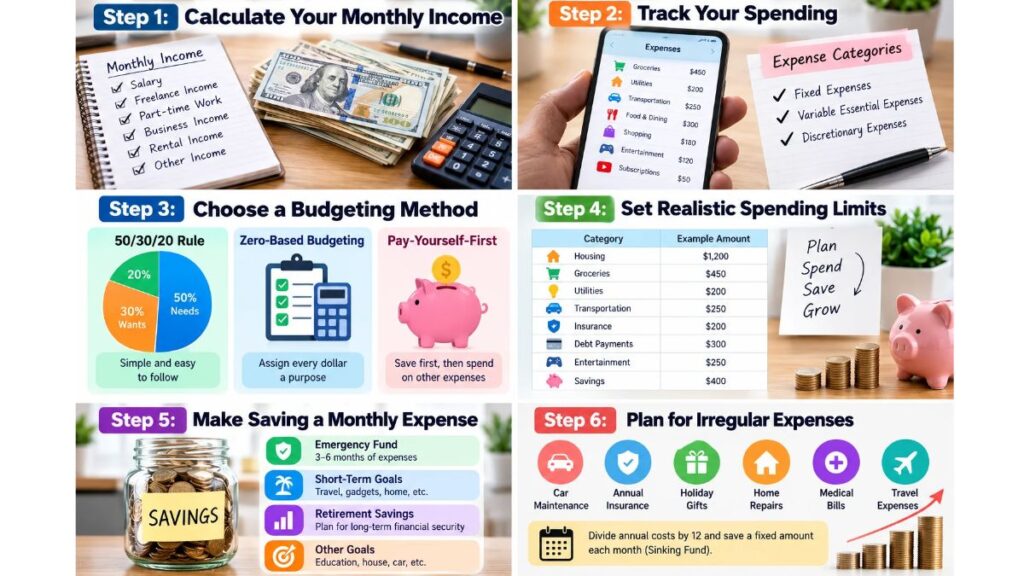
When an annual $600 car insurance premium arrives in March, it isn’t an emergency; it’s a predictable expense with a known timeline. To handle these, set up sinking funds: divide the estimated annual cost by 12 and transfer that slice into savings every month. When the bill comes due, the cash is already waiting.
4. Pick a Budgeting Method That Fits Your Brain
A budgeting framework is simply a mental model. Choose the one that matches how your brain naturally organizes information.
| Budgeting Method | Best Suited For | Core Philosophy | Potential Pitfall |
| 50/30/20 Rule | Beginners, salaried workers | High-level percentages (Needs / Wants / Savings) | Rigid in high-cost-of-living areas |
| Zero-Based Budgeting | Detail-oriented planners, debt-crushers | Every dollar is assigned a job before the month starts | Requires frequent check-ins |
| Pay Yourself First (Reverse) | People who hate tracking micro-expenses | Automate savings and bills first; spend the rest | Easy to overspend early in the month |
| Envelope / Cash System | Chronic credit card overspenders | Physical or digital cash envelopes for problem areas | Cash handling can feel inconvenient |
Method 1: The 50/30/20 Rule (Best for Beginners)
Popularized by Senator Elizabeth Warren, this framework splits your after-tax income into three broad buckets:
50% Needs | 30% Wants | 20% Savings & Debt
- 50% Needs: Everything required to keep a roof over your head, food on the table, the lights on, basic health covered, and minimum debt payments satisfied.
- 30% Wants: Dining out, entertainment, hobbies, travel, streaming services, and designer clothes.
- 20% Savings & Accelerated Debt: Emergency fund contributions, retirement accounts above employer matches, and extra principal payments toward high-interest debt.
Reality Check: If you live in an expensive metropolitan area, your housing costs alone might consume 40% of your income, pushing needs to 60% or 70%. That’s okay. Treat 50/30/20 as a compass, not a legal statute. If your current ratio is 70/20/10, aim to adjust it gradually over time as income rises or debts clear.
Method 2: Zero-Based Budgeting (Best for Maximizing Every Dollar)
Zero-based budgeting does not mean keeping zero dollars in your bank account. It means:
$$\text{Income} – \text{All Expenses (including savings and investments)} = \$0$$
Every dollar has a specific assignment before the calendar month begins. If you bring home $4,000 this month, every single dollar is pre-allocated across rent, food, debt payments, investments, and entertainment until there are zero unassigned dollars floating around.
Unassigned money in a checking account is money that mysteriously disappears on delivery apps and impulse shopping.
Method 3: The “Pay Yourself First” Approach (Reverse Budgeting)
If tracking line items drives you crazy, reverse the process:
- Determine how much you need to save each month to hit your emergency or retirement goals (e.g., $500).
- Set up an automatic transfer so that $500 leaves your checking account on the morning of payday.
- Pay your fixed monthly bills (rent, utilities, insurance, loan payments).
- Whatever remains in your checking account is yours to spend freely on food, coffee, clothing, and fun until the balance hits zero.
As long as your bills are paid and your savings are locked away automatically, you don’t need to track individual categories.
Method 4: The Cash Envelope System (Best for Habit Breaking)
If your primary hurdle is swiping plastic or tapping your phone until your checking account balance evaporates, use tangible physical friction.
- Identify your 2–3 biggest leak categories (typically dining out, weekend entertainment, or impulse Target trips).
- Withdraw the budgeted amount in cash at the start of each week or pay period and place it in labeled physical envelopes.
- Once the cash inside the “Dining Out” envelope is gone, you are done eating out until the next envelope refill. No borrowing from other envelopes.
5. Build Your Budget Step-by-Step
Let’s walk through an actionable example of building a monthly budget using clear figures.
Step 1: Establish Your Starting Net Income
Assume a take-home pay of $4,500/month.
Step 2: Total Your Essential Fixed Expenses
- Rent & Renter’s Insurance: $1,550
- Utilities (Power, Water, Internet, Phone): $320
- Car Payment, Gas & Auto Insurance: $580
- Minimum Debt Payments (Student Loans): $150
- Total Fixed Essentials: $2,600 (57.8% of income)
Step 3: Set Priority Savings and Debt Payoff Targets
Before adding discretionary spending, allocate cash toward your security foundation:
- Emergency Fund Contribution: $350
- Extra Principal on Highest-Interest Debt: $250
- Total Future/Security Allocation: $600 (13.3% of income)
Step 4: Map Your Variable Living Expenses
- Groceries: $500
- Routine Personal Care & Household Consumables: $150
- Sinking Fund (Car Maintenance, Medical, Annual Subscriptions): $250
- Total Variable Living Expenses: $900 (20% of income)
Step 5: Assign Your Discretionary “Guilt-Free” Spending
Calculate what remains:
$$\$4,500 – (\$2,600 + \$600 + \$900) = \$400$$
- Dining Out & Socializing: $250
- Hobbies, Streaming & Entertainment: $150
- Total Discretionary: $400 (8.9% of income)
Your balance reaches exactly $0 unallocated dollars. Every dollar has an assigned role.
6. Pick Your Budgeting Tool
Do not overcomplicate your setup on day one. Choose the tool that creates the lowest barrier to consistency:
- Pen and Paper / Notebook: Zero learning curve, high intentionality. Writing transactions down by hand creates physical awareness of spending.
- Spreadsheets (Google Sheets / Microsoft Excel): Completely customizable, free, private, and powerful. Excellent for people who enjoy formulas and want complete control over their financial records.
- Dedicated Mobile Apps (YNAB, Monarch Money, Copilot, EveryDollar): Offer automated bank feeds, real-time transaction syncing, and multi-device access. Ideal for busy professionals or couples who need shared access.
If you are just starting out, use a basic spreadsheet or notebook for the first two months. Building the mental muscle of categorizing your cash manually helps you internalize your true spending habits faster than automated software.
7. The Three Non-Negotiable Rules to Prevent Budget Failure
           ┌──────────────────────────────────────┐
           │   WHY TRADITIONAL BUDGETS COLLAPSE   │
           └──────────────────┬───────────────────┘
                              ▼
   ┌──────────────────────────┼──────────────────────────┐
   ▼                          ▼                          ▼
Too Restrictive         Ignoring Sinking Funds      No Buffer Cushion
No fun money leads      Annual car insurance       Every minor bump
to binge spending       breaks the entire system   creates an overdraft
To make sure your budget lasts more than two weeks, follow these three practical rules:
1. The “Miscellaneous” Cushion is Mandatory
Never budget down to the exact penny in your main checking account without a buffer. Always leave a permanent $100 to $250 cash cushion in your primary checking account. This absorbs forgotten minor charges, an unexpected price jump at the grocery store, or an unannounced annual fee without causing an overdraft fee or forcing you to pull money out of your savings.
2. Include “Guilt-Free” Fun Money
A budget with zero allocation for joy is doomed. If you cut out your morning coffee, Friday pizza, and weekend movie nights all at once, you will experience financial deprivation fatigue and binge-spend within a month. Even if it is only $30 a week, set aside money that can be spent on whatever you want—guilt-free, question-free, and receipt-free.
3. Review Weekly, Not Monthly
A monthly budget is too long to manage if you only check it every 30 days. Finding out on day 28 that you overspent your food budget on day 12 leaves you helpless.
Schedule a non-negotiable 10-minute “Money Date” every Sunday evening:
- Log or categorize your expenses from the past seven days.
- Look at the balances remaining in your variable categories.
- Adjust your plan for the week ahead (e.g., if you overspent on dining out this weekend, plan two low-cost meals for Tuesday and Thursday).
8. What to Do When Your Budget Breaks (Because It Will)
A common misconception is that a successful budget is one where every category hits its target number with pinpoint precision.
In the real world, a successful budget is one that adapts without falling apart.
- If you overspend in one category: Practice the “seesaw principle.” If you spend $60 more on groceries than planned, pull $60 out of your dining-out or entertainment budget for the rest of the month. The bottom line stays intact.
- If your income drops: Immediately switch to your “Four Walls” budget: Food, Shelter/Utilities, Basic Transportation, and Health. Everything else (streaming, dining, extra debt payments) is paused until baseline stability returns.
- If an actual emergency hits: Use your emergency fund for genuine emergencies (unplanned, necessary, urgent events like emergency surgery or sudden job loss). That is what it exists for. Do not feel guilty for drawing from savings to stay afloat.
Your 7-Day Quick-Start Action Plan
Stop planning to budget, and put a simple system into motion this week:
- Day 1: Print your bank statements. Pull the last 60 days of activity from your primary checking and credit card accounts.
- Day 2: Identify your fixed essentials. Highlight rent, insurance, car payments, utilities, and loan minimums. Calculate the monthly sum.
- Day 3: Calculate your take-home pay. Confirm your baseline monthly net income.
- Day 4: Establish 3 sinking funds. Estimate annual costs for car care, holiday spending, and medical expenses. Divide each by 12.
- Day 5: Choose your system. Select either the 50/30/20 framework, zero-based budgeting, or a simple spreadsheet.
- Day 6: Draft your first month. Assign your dollars to bills, savings, variables, and personal spending until every dollar has a role.
- Day 7: Put your first “Money Date” on the calendar. Set a recurring 10-minute calendar invite for next Sunday to review your first week of real-world tracking.
Remember: the first two months of any budget are always a rough draft. You will miss categories, underestimate expenses, and need to rebalance numbers mid-stream. That isn’t failure; it’s calibration. Stick with it through the first 90 days, and the cycle of paycheck-to-paycheck stress will turn into quiet, predictable control.
Final Thoughts: Build a Budget You Can Actually Follow
Learning how to create a monthly budget is an important step toward taking control of your financial future.
You do not need to make dramatic changes overnight. Start by understanding your income, tracking your expenses, and deciding how much you can realistically save.
Choose a budgeting method that fits your lifestyle, plan for irregular expenses, and review your progress regularly.
Remember that budgeting is not about eliminating every purchase you enjoy. It is about making deliberate choices so that your money supports your needs, priorities, and long-term goals.
Your first step is simple: calculate your monthly take-home income, list your essential expenses, and decide on one realistic savings goal for the coming month.
Once you build that habit, you can gradually improve your spending decisions, strengthen your emergency fund, reduce financial stress, and make meaningful progress toward the future you want.
A successful budget is not the one with the most complicated spreadsheet or the strictest spending rules. It is the one you can follow month after month.
Frequently Asked Questions About Monthly Budgeting
ANS- Start by calculating your take-home income and tracking your expenses. Divide spending into essential bills, discretionary purchases, savings, and debt payments. Choose a budgeting method, set realistic limits, and review your progress weekly.
ANS- The 50/30/20 rule is a budgeting guideline that allocates approximately 50% of after-tax income to needs, 30% to wants, and 20% to savings and additional debt repayment.
These percentages are flexible guidelines, not mandatory limits. Adjust them to match your cost of living and financial priorities.
ANS- The right amount depends on your income, essential expenses, debt, and goals.
Saving 20% of your take-home income is a common target, but it may not be realistic for everyone.
If you cannot save that much, start with an amount you can maintain consistently. Increase your savings when your income rises or expenses decrease.